Whether in times of war or peace, money is always an essential. This was particularly the case in late Qing China, a period when social and political instability affected not only the Chinese but also foreign settlers and businesspeople in China. At the time, the newspaper was an important source of information. Occurrences around the world, such as the news article below, published on 14th January 1878 in The London and China Telegraph, would be of interest to some people.1
HANKOW.
The North China Daily News correspondent writes as follows:–
Trouble is coming on this autumn. During the last five days ten banks (large and small), have “burst” up, and more are expected to follow. None of the big banks will do discount pidgin now, as it is difficult to know who to be safe with. During all this the mandarins seem to be prospering, and go on their usual style of squeeze. Only last month the Taoutai here, who was transferred to Foochow, took away with him his six years’ plunder in the shape of about seven lakhs of taels. This is well-known in native circles—rather good! Part of the Hong Kong and Shanghai Bank loan to the Chinese has arrived here, in fact nearly all, and is being forwarded as fast as possible to Tso Tsung-tang. The Russian hongs here are to be paid for the supplies furnished by a Russian merchant to Tso during his Kashgar campaign. It is said it amounts to three lakhs of taels; but the Taoutai has ordered the Haiquan banks at present to get ready Tls. 150,000, awaiting formal orders to hand over the amount. The Hornet arrived yesterday, after a fourteen days’ trip from Shanghai, to relieve the Sheldrake, going to Chefoo.
The news reported the situation in Hankow, China. Located in Hubei Province. The Treaty of Tientsin (1858) designated Hankow (also spelt Hankou) as a treaty port and was opened for foreign trade in 1861. There were five foreign concessions in Hankow: British, French, Russian, German, and Japanese. Hankow’s Chinese name 漢口 means “at the mouth of the Han River”, which is at the confluence of the Yangtze River. Wuhan (武漢), the current provincial capital of Hubei, was formed by merging Hankow, Wuchang (武昌), and Hanyang (漢陽). Though the English name Hankow or Chinese 漢口 is no longer officially used, its legacy lives on in names like Hankow Road in Hong Kong.
While the gist of the news is quite clear, the meanings of some words there, namely: pidgin, squeeze, lakhs, taels, mandarins, taoutai, Tso Tsung-tang, hongs, Haiquan, and Kashgar are now obscured. Many foreign words entered the English lexicon during the British imperial expansion between the 17th and 19th centuries. British interest in India was initially mediated through the East India Company. The word lakh is found in languages spoken in India. In the Indian numerical system, one lakh equals one hundred thousand (100,000). In Southeast Asia, Britain occupied Penang in 1786, Singapore in 1819, and Malacca in 1824, forming the Straits Settlements. Since Malay was the lingua franca of the region, some Malay words like tael entered the English language.In Malay, tael, usually spelt tahil, is a unit of weight. When the word was brought to China, it was translated as 兩 in Chinese. Besides its original usage, tael was also used as a monetary unit (Tls). Different proposals have been put forward to explain the origins of pidgin. A common belief is that it is derived from the English word business.
In the 18th century, a pidgin English developed in Canton (Guangzhou). As a result, there was a means for direct communication between Chinese and Westerners. In pidgin English, pidgin means ‘business, affair.’ The name pidgin also refers to a language formed by people speaking different native languages. The pidgin functions as a lingua franca to allow cross-cultural communication, but its domains of use are limited. The English variety developed in Canton, also called Canton English, is a pidgin. The meaning of words may change when languages come into contact. A good example is squeeze. In the news article, squeeze should not be understood in its usual sense despite its English origin. It acquired a new meaning: ‘extortion’ or ‘bribery’ in pidgin English.
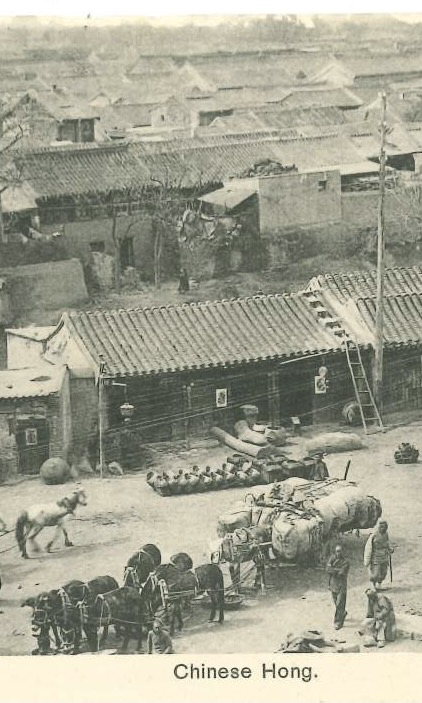
Names of people and places of historical or cultural importance also appeared in the news. The mandarins were public officials of imperial China. They did not directly deal with the so-called “foreign devils” (i.e., foreigners), but relied on the hong merchants to communicate or negotiate with them. Hongs in “Russian hongs” refer to firms or companies. The word is derived from Cantonese 行hong2 ‘a shop, a firm.’ Before 1842, Canton was the only port where foreigners could trade, and the area designated for foreigners to trade and reside was known as 十三行 ‘Thirteen Factories.’ The factory, derived from Portuguese feitoria ‘trading post,’ was the office or warehouse, or in Cantonese hong in 行hong2. Acting as licensed intermediaries between the Chinese government and foreign traders, the hong merchants had a monopoly over foreign trade, making them not only a special group but also wealthy and influential. The most famous and prominent of these hong merchants was Houqua (Wu Bingjian 伍秉鑑), who was head of the Ewo Hong and leader of the Co-hong, a guild of the hong merchants. The First Opium War (1839-1842) ended this system because ports in Shanghai, Ningpo, Foochow, and Amoy were also opened for foreign trade. Moreover, Hong Kong Island was ceded to Britain and became a free port. Another type of official in China was the taoutai 道台 (pinyin: daotai). They were circuit intendants who oversaw the administration, law, tax, tariff, and foreign relations of a circuit or dao 道 in Chinese. The Haiquan (海關) in Hankow was one of the major customs houses in China.
Tso Tsung-tang (左宗堂; 1812–1885) was a high-ranking official and an influential politician of the Qing dynasty, leading the Xiang Army (湘軍) and supervising the construction of the Foochow Arsenal (福州船政局). In the West, his name is associated with a dish named after him – General Tso’s chicken (左宗堂雞). One of his victories was the suppression of the rebellions of the Muslim Hui (回) people in Shaanxi, Gansu, and Xinjiang against the Qing dynasty in the 1850s-70s. Located in southern Xinjiang, Kashgar (喀什; pinyin: Kashi) was conquered by the Qing dynasty in 1759. In the revolt in Xinjiang, Yakub Beg controlled the Tarim Basin and proclaimed himself ruler of the new state Yettishar (or Kashgaria). The Qing government appointed Tso Tsung-tang to put down the revolt, and in 1877 the death of Yakub Beg dresulted in Kashgar falling to Qing’s control again.2
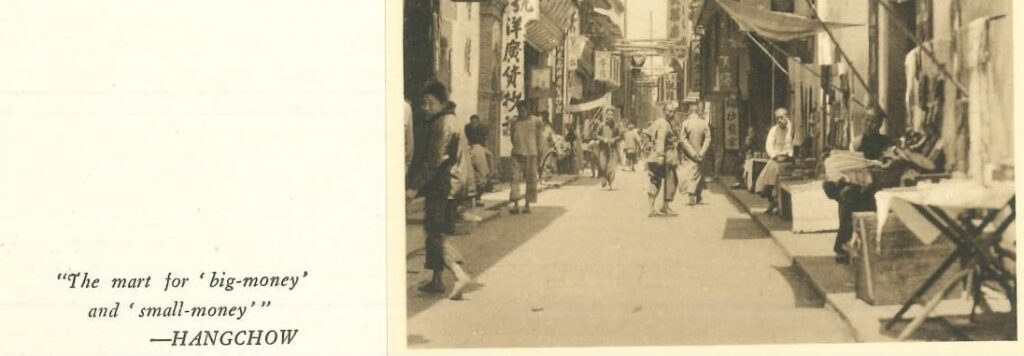
Money was a concept that created much confusion in 19th- and 20th-century China. Apart from the taels mentioned in the news article, multiple currencies, both native and foreign, were in circulation during this period. One kind of confusion was created by the two mysterious terms shown in the featured card above: The mart for ‘big money’ and ‘small money’ – Hangchow. Hangchow (pinyin: Hangzhou) is the provincial capital of Zhejiang (浙江). Hangzhou is best known for its beautiful natural scenery, which is evident in the Chinese saying: 上有天堂 下有蘇杭 “There is heaven above; there are Su-Hang on earth.” Su-Hang (蘇杭) refers to Suzhou and Hangzhou respectively.
Complications caused by the mixed currencies had existed in China for centuries. In the 16th century, the Manila-Acapulco Galleon Trade involved traders from the Philippines who bought Chinese goods in southern China, shipped them to Manila, and then transported them for sale in Acapulco, Mexico. This trade resulted in the use of Spanish silver dollars in China. In the 19th century, the Spanish dollar was replaced by the Mexican dollar and the British and American trade dollar. Silver was also used as a currency in China, but it was usually molded into sycee or “shoes.” Attempts to standardize the Chinese currency were made by the Qing government in the late 19th century. A silver dollar usually weighed 7 mace and 2 candareens or 0.72 tael. 1 tael 兩 of silver equals 10 mace 錢 or 100 candareens 分 or 1,000 cash 文. The unit tael also differed from place to place as there were Kuping taels, Haikwan (Customs) taels, Tsaoping taels, and many other taels, resulting in complications in conversion.3 The Republic of China (mainland) standardized the currency and called it yuan 圓(元). Silver dollar was referred to as “big money.” The subsidiary smaller denominations like 10-cent and 20-cent coins, suitable for everyday small transactions, were “small money.” Originally, decimal fractions were adopted, but overproduction of subsidiary coins resulted in depreciation of “small money.”
To help American traders better understand the currency system in China in the early 20th century, the U.S. Department of Commerce explained as follows.4
“One dollar is usually worth 11 dimes and from 2 to 7 copper cents and a few brass cash—depending upon exchange. It is necessary, therefore, in all transactions to have an understanding as to whether the deal is in “small money” (11 dimes, plus, to the dollar) or in “big money” (10 dimes to the dollar). A great many counterfeit coins are in circulation, and many have lost, and are losing value through “sweating.” It is necessary to “shroff” every coin received.”
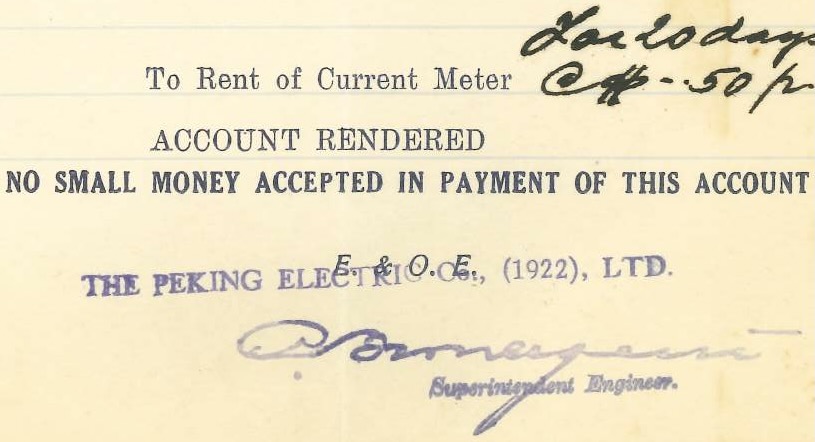
“Sweating” was a method to remove silver from coins for profit. This resulted in the debasement of the coins, and a shroff who tested the purity of the coins was needed to avoid counterfeits. Because of the fluctuation of the value of “small money,” this results in the difference in price depending upon the type of money used for transaction described in The Chinese Economic Bulletin (1925).5
“Take, for instance, the lot of Kiaotouchieh now occupied by the new building of the Chung Hwa Book Company (中華書局). The lot covers 1.6 mow, formerly occupied by a shanty of about 20 rooms. The company bought the property at a total price of $2,000 “small money” (about $1,700 “big money”) in 1923.”
Money has no fixed value. The situation of China in the 19th and 20th centuries illustrated how the value of money was inseparable from social and political changes.
1. The London and China Telegraph. 1878. “Hankow”. Monday, Jan. 14, 1878. Vol. XX. No. 750, p. 43.
2. Hsü, Immanuel C. Y. 2000. The Rise of Modern China. 6th ed. New York: Oxford University Press.
3. Morse, H. B. 1908. The Trade and Administration of the Chinese Empire. London: Longmans, Green, and Co.
4. Arnold, Julean. 1919. Commercial Handbook of China. vol. 1. Washington: Government Printing Office.
5. The Chinese Economic Bulletin. 1925. Peking; Shanghai: The Chinese Government Bureau of Economic Information. May 9. No. 220, p. 267.