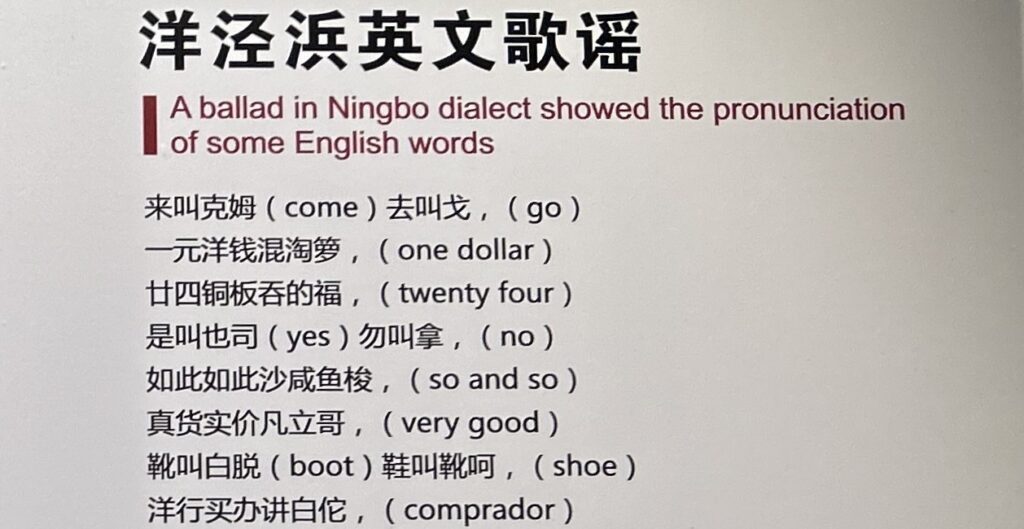
Learning English in the way shown in the featured image above looks bizarre today. However, if you were in 19th-century China this was a common method. In Shanghai, this kind of English was known as Yang Jing Bang English (洋涇濱英語) (i.e., Pidgin English) named after the creek Yang Jing Bang in Shanghai. Interestingly, the dialect used to transliterate the English words was not the Shanghai dialect but the Ningbo dialect. This suggests the impact of the Ningbo people in Shanghai.
The Chinese name 寧波 means ‘tranquil waves.’ It was previously Anglicised as Ningpo but is now spelt Ningbo according to Hanyu Pinyin. It is a coastal city located in the east of Zhejiang Province (浙江省) in eastern China. The city was referred to by different names at different periods – 鄞 (Yín), 句章 (Gouzhang), 明州 (Mingzhou), and the current name 寧波 was adopted in the Ming dynasty. The city name is also abbreviated as Yong (甬), as in place names like 甬江 (Yong River) and 甬山 (Yong Hill) and the intangible cultural heritage 甬劇 (Yong opera). The city has a long history of trading connections with Japan and Korea dating back to the Tang and Song dynasties. It was also one of the locations where the Portuguese traded in the early 16th century. Ningbo was designated as one of the five treaty ports after the signing of the Treaty of Nanking in 1842. For over a thousand years, Ningbo has occupied a vital role in trade and commerce. Linguistically, the city was made known through the expression “go Ningpo more far” in Chinese Pidgin English.
Throughout history, Ningbo and its merchants went through ups and downs. One of the early forms of cross-cultural connections was religious exchanges. Buddhism is the most deep-rooted and prominent religion in the city. The first temple in Ningbo was built in the 3rd century. The city has preserved many historically significant temples and continued to serve as one of the centres in China for the conservation of Buddhist architecture and the spread of Buddhism. Ningbo rose to prominence culturally and commercially during the Tang and Song dynasties (7th – 13th century). As a major hub of Buddhism, there were frequent official exchanges with delegates from Japan and Korea, especially in the area of religious interactions. Private merchants also benefitted from trading in the art and craft of Buddhism, which indirectly promoted the study of Buddhism in East Asia. Ningbo was also one of the places where Westerners, namely the Portuguese, first visited in the 16th century. There was evidence of Portuguese trading activities at Shuangyu (雙嶼港), where it was referred to as Liampó (derived from Ningbo) in Portuguese sources.
As a result of the severity of piracy along the China coast, the Ming government declared a sea ban prohibiting all maritime activities and forcing coastal inhabitants to retreat inland. The deserted Shuangyu, which lay off the coast of Zhejiang, became an ideal base for smugglers and illicit traders from Portugal, Japan, and Southeast Asia. An extensive Chinese-Portuguese-Japanese trade network was established with Shuangyu functioning as a supply point. The illegal trade grew rapidly and the Ming government decided to eradicate Shuangyu. Many Portuguese were killed during the destruction of the smuggling base; the remaining Portuguese fled to Canton to continue their trade. In 1575, the Portuguese were eventually allowed to settle in Macau. The Qing government relaxed the sea ban in 1684 and established four customs offices to collect duties and manage affairs relating to foreign trade. One of these customs was in Ningbo. However, restriction on foreign trade was again imposed in 1757 by limiting all foreign trade to Canton and the other three customs were defunct.
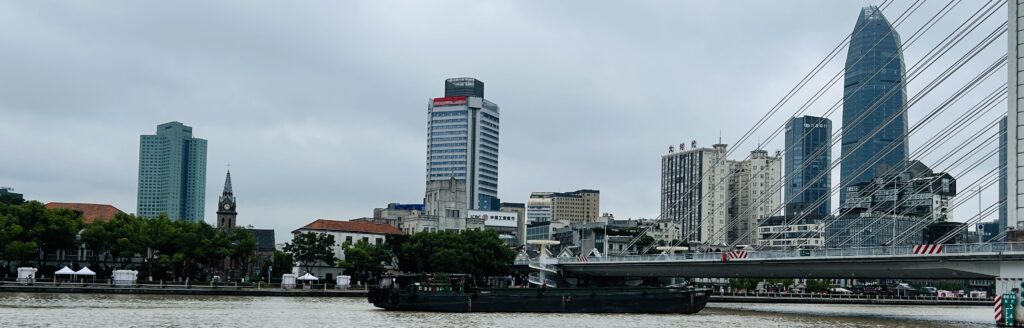
A new era of Sino-West relations began in the 19th century. China’s defeat in the First Opium War (1839–1842) and the signing of the Treaty of Nanking led to the opening of treaty ports in Ningbo, Shanghai, Amoy (Xiamen), Foochow (Fuzhou), in addition to the existing port in Canton. For the Western powers, the war meant not only victory but also unprecedented concessions and influences in areas including commerce, diplomacy, and military in China. Since Canton was severely damaged after the war, there was a shift of foreign interests and investments from Canton to Shanghai and the newly founded British colony – Hong Kong.
Outcomes of contact between the Chinese and Westerners went beyond commercial exchanges, a new means of communication – Chinese Pidgin English – emerged in Canton in the 18th century, a time when Canton was still the only port where foreigners could trade with the Chinese. Both Chinese and Westerners employed Chinese Pidgin English as a lingua franca to communicate with each other. As China opened its door to the West, Pidgin English travelled towards the north, particularly in Shanghai, where it was popularly used in various types of cross-cultural interactions. In Shanghai, Pidgin English was also referred to as Yang Jing Bang English (洋涇濱英語), named after a creek in the international settlement. The following dialogue in Pidgin English was reconstructed by Carl Crow (2011), who was a long-time resident and writer in Shanghai. The interlocutors were a Chinese compradore, i.e., a buyer, and a European taipan, i.e., the head of a firm.1
Taipan: How fashion that chow-chow cargo he just now stop godown inside?
Compradore: Lat cargo he no can walkee just now. Lat man Kong Tai he no got ploper sclew.
Taipan: How come you talkie sclew no ploper? My have got sclew paper safe inside.
Compradore: Aiyah! Lat sclew paper he no can do. Lat sclew man he have go Ningpo more far.
A foreigner trading in China must have a Chinese merchant acting as his guarantee or ‘security.’ Therefore, the disappearance of Kong Tai meant big trouble. As you can see, Pidgin English is neither Cantonese nor English but a blend of both. While most words are derived from English, a few non-English words require explanations. Chow-chow, believed to be derived from Chinese, could mean ‘food,’ ‘to eat,’ or ‘mixed, assorted’ as in the example above. A godown comes from Hindi and means a warehouse. Aiyah is a typical Cantonese exclamatory expression. The spellings of some words may look obscure. This is because they try to reflect some characteristics of pronunciation in the pidgin, for example, “l” instead of “r” or “th”. The word sclew refers to secure. There are no inflections in Pidgin English, therefore, grammatical meanings like tense and number are inferred from the context. The conversation ended with the expression “go Ningpo more far,” which means Kong Tai had absconded. But why Ningbo and not other places? To answer this question, we should understand the situation of Ningbo as a treaty port.
While both Ningbo and Shanghai became treaty ports after the signing of the Treaty of Nanking (1842), their significance and development were drastically different. If you draw a straight line between Ningbo and Shanghai, the distance is only about 150 km. However, Shanghai had a geographical advantage over Ningbo in terms of maritime commerce, transportation, and defense. The international settlements of Shanghai were located at the Yangtze River Delta. Yangtze River (in Chinese it is called 長江, which means ‘Long River’) is the longest river in Asia. For a long time, the river has been vital for agriculture, transportation, food and water supplies, and cultural and commercial exchanges. The Rong River in Ningbo is comparatively speaking less important in function.
Moreover, many Ningbo merchants had already gone to Shanghai to seek new opportunities such as acting as compradores or linguists before Shanghai was officially opened as a treaty port. 穆炳元 (Mu Bingyuan) of Dinghai, Zhaoshan city was the first compradore in Shanghai and allegedly the author of the Pidgin English ballad above. 王槐山 (Wang Huaishan) of Yuyao was the first compradore of Hongkong and Shanghai Banking Corperation in Shanghai. So, while Shanghai was thriving and became the “Paris of the Orient”, Ningbo in 1854 was ‘the quietest place under the sun. A handful of merchants lived there, buried without the trouble of dying; one or two consulates had been built, but roads were non-existent, and the few houses were separated from one another by a network of paddy (rice) fields.” (Bredon 1909).2 So, “go Ningpo more far” was an evasive way to indicate that someone disappeared in some faraway places and was unlikely to return.
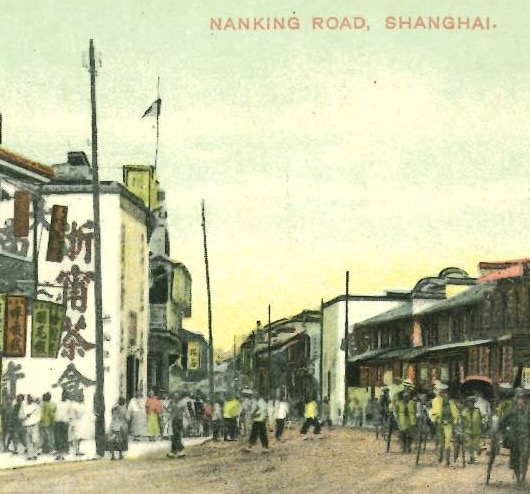
Although prosperity never came to Ningbo, due credit should be given to the Ningbo merchants who contributed immensely to the development of banking, industry, manufacturing, cinema, etc. in Shanghai. The Ningbo merchants were also advanced thinkers who understood the importance of acquiring Western knowledge such as the English language. Six Ningbo merchants compiled a phrasebook entitled 《英話注解》to help the Chinese learn English, or more precisely Pidgin English. Published in 1860, the book used Chinese characters to transliterate the sounds of English. Since the authors came from Ningbo, the Ningbo dialect was used to pronounce the characters. Similar pidgin English phrasebooks were also found in Canton before the Opium War, but people from Ningbo and Shanghai could not use them readily as Cantonese was used for transliteration.
After the Second World War, a considerable number of Chinese immigrants in Hong Kong had an ancestral connection with Ningbo. Their contributions to post-war Hong Kong are evident in a wide range of industries: shipping (Sir Yue-kong Pao 包玉剛爵士, Tung Chao-yung 董浩雲), textile (James Lee 厲樹雄), cinema and television (Sir Run Run Shaw 邵逸夫爵士), music (李子文 Thomas Lee Tse-vung, founder of Tom Lee Music), to name just a few. Although Ningbo is not as bustling and vibrant as Guangzhou, Shanghai, and Hong Kong, the impact of Ningbo people in historical and modern China is unequivocal.
Bredon, Juliet. 1909. Sir Robert Hart: The Romance of a Great Career. London: Hutchinson & Co.
Crow, Carl. 2011. Foreign Devils in the Flowery Kingdom. Hong Kong: Earnshaw Books, Ltd.